
Short answer: conveyor fires almost always start the same way — an idler bearing seizes, friction heats the roller to ignition temperature against a moving rubber belt, and the fire rides the belt into the gantry. The failure is thermal, gradual, and localizes to a single roller — which makes it detectable early by a distributed temperature sensor (DTS) watching every meter of the conveyor line. This guide covers the failure mechanism, what to check when buying a fiber-optic detection system, and the specification questions that separate real systems from demo-yard claims.
Author: Landsub Engineering Team Category: Application Guide | Reading time: ~8 min
Why conveyor fires are a line-side problem, not a point problem
A 3 km overland conveyor can carry more than 2,000 idlers. Every one of them is a bearing under load, in dust, at speed. Traditional protection treats this as a point problem — thermal cameras at head sections, spot heat detectors every 30-50 m, ambient smoke detectors that need smoke to travel to them. The gap is structural:
- The ignition point can be anywhere along the line, most often mid-span where nobody walks.
- A seized idler heats gradually — detectable 10-60 minutes before flame if you can see its temperature. If your detector spacing is 50 m, you may have no sensor within 25 m of the failing roller.
- Smoke detectors react after combustion, when the belt surface is already burning and the fire is riding the belt at 3-4 m/s into the gallery.
What DTS changes about the detection math
A single DTS channel on a fiber routed along the conveyor (tray, gantry or belt structure) measures temperature at every 0.8 m along up to 30 km per channel:
| Capability | What it means on a conveyor |
|---|---|
| Continuous 0.8 m resolution | Every idler position is implicitly monitored — no sensor spacing gap |
| ±0.5 °C absolute accuracy (0.1 °C resolution) | Distinguishes a warm idler from ambient dust heating; tracks a deteriorating bearing across days |
| Rate-of-rise alarms | A bearing running away raises local temperature faster than solar or process noise — ROR catches it before absolute thresholds |
| Zone-based thresholds | Head/tail sections, drive houses and transfer points get their own alarm profiles |
| Post-event heat mapping | After any incident, the full thermal history is evidence for root-cause analysis |
The detection sequence in practice:
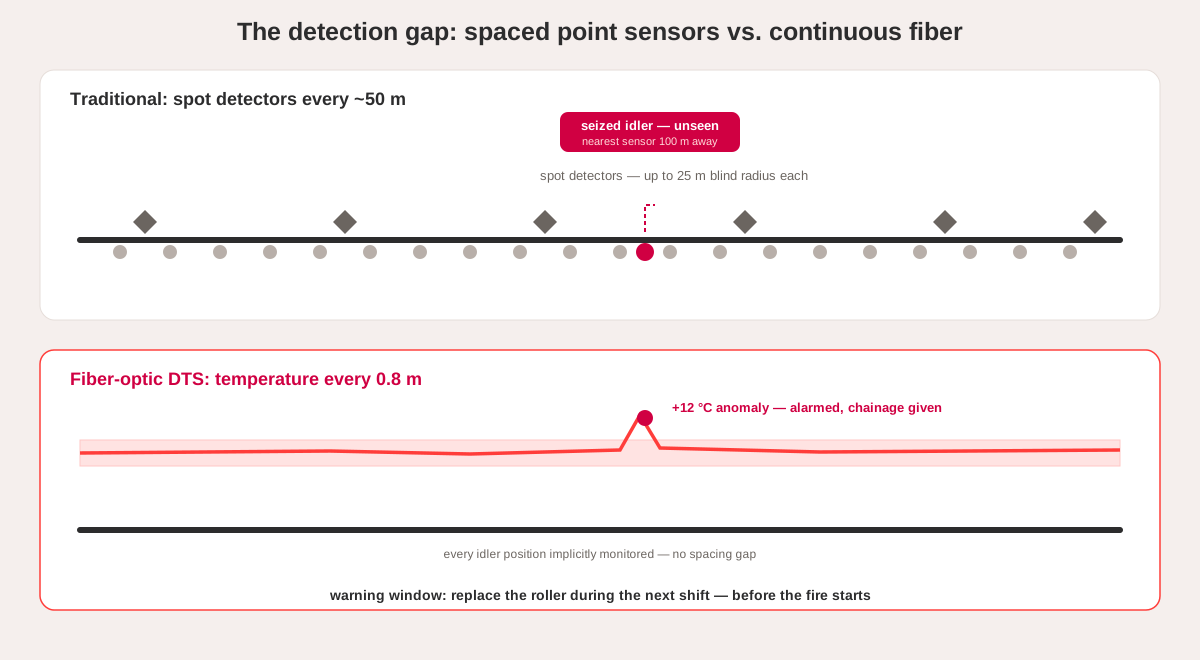
bearing degradation shows as a local +5-15 °C anomaly against neighboring idlers → maintenance replaces the roller during the next shift → the fire never starts. This is "turning 'we learn a roller has failed when the line stops' into 'we get warned before the roller fails'" — the core economic argument, since one unplanned belt replacement or gallery fire costs multiples of the monitoring system.
Buyer's checklist: eight questions before you sign
1. Coverage per channel at full resolution — vendors may quote 30 km range at degraded resolution. Ask for the range at 0.8 m. 2. Alarm logic — absolute threshold AND rate-of-rise AND inter-zone comparison, all programmable per zone. 3. Accuracy labels — ±0.5 °C is absolute accuracy; 0.1 °C is resolution. Systems quoting only "0.1 °C" are hiding the absolute figure. 4. Fiber routing survey included? — the fiber layout determines which idler positions get direct sensing vs. inferred coverage. Demand a routing design, not just a box. 5. Integration with belt control — alarm output to the PLC/SCADA for automatic belt stop or slowdown, with dry contacts or Modbus. 6. Environmental rating of the interrogator — mine substations are dusty and hot; check IP rating and operating temperature. 7. False alarm behavior across seasons — dust storms, direct sun on the line, and seasonal swing must not become alarm sources. 8. Upgrade path — can detection software (AI models) be upgraded in the field without replacing hardware?
Where DAS adds value on the same line
Thermal detection does not see mechanical threats: belt tear, foreign objects jamming the chute, or vandalism along open overland sections produce acoustic signatures, not heat. A DAS channel on the same fiber covers these — and AI-based pattern recognition on existing DAS/DVS units (≥95% DAS / ≥90% DVS recognition accuracy) lets aging installations upgrade their classification without replacing hardware. For ports, DAS on the conveyor corridor can double as perimeter awareness.
The standards and certification landscape
Detection systems for fibre optic sensing align with the IEC 61757 series. For the belt itself, EN 12882 governs electrical and flammability safety requirements of conveyor belts — your detection system complements, but does not replace, belt-grade compliance. For underground coal applications, check local mining authority certification requirements for intrinsically safe installations; surface mining and port gantries face lighter certification paths.
FAQ
We already have thermal cameras at the drives. Is that enough?
How long does installation take on a live conveyor?
What does a system cost relative to one fire?
This article aligns with the IEC 61757 series (fibre optic sensors). Landsub Global engineers combined DTS/DAS monitoring architectures for mining and port conveyors — [landsubglobal.com](https://www.landsubglobal.com/en/solutions/mining).