
UAV Pipeline Inspection — DAS-Triggered Automated Drone Response
UAV pipeline inspection that flies only when it matters: DAS fiber sensing detects intrusion or leak events with meter-level coordinates, and the nearest drone is dispatched automatically for visual verification — a closed loop from detection to response.
What is DAS-triggered UAV pipeline inspection?
DAS-triggered UAV pipeline inspection is a response layer built on distributed fiber optic sensing. The DAS system monitors the pipeline corridor continuously — up to 160 km (dual channel) per channel — and its AI pattern recognition, at ≥95% accuracy on upgraded systems, identifies third-party excavation and leak signatures and localizes them to meter level. Only then does a drone fly: the confirmed alarm carries precise coordinates to the coordination platform, which dispatches the nearest UAV to verify visually, deter remotely and record evidence. Every flight is tied to a real, located event along the line rather than a calendar slot, so patrol effort concentrates on the moments that matter.
Why scheduled patrols alone can't protect a pipeline
Patrol routes cover too little, too late
Long-haul pipelines cross farmland, mountains and rivers; a scheduled patrol cycle leaves hours or days of blind spots — exactly the window an excavation needs to strike.
Sensing without eyes delays confirmation
A vibration or leak alarm is only the beginning. Without fast visual confirmation, control centers either wait for staff to drive out or waste crew hours chasing false alarms.
Manual verification is slow and costly
Sending staff to every alarm raises operating cost and exposure; in remote sections a single verification trip can take hours, during which the event evolves unattended.
Evidence is lost before anyone arrives
By the time people reach the site, machinery has often left — no footage, no deterrence, and the same violation repeats on the next section of the line.
The closed loop: sense → classify → dispatch → verify
UAV pipeline inspection works as Layer 3 of the fiber-sensing solution — every drone flight is triggered by a located event, not a calendar.
DAS watches every meter
Distributed acoustic sensing listens along the pipeline's co-located fiber, 24/7, covering the full corridor — up to 160 km (dual channel) per DAS channel — with no patrol gaps.
AI confirms the event
AI pattern recognition distinguishes excavation, machinery and manual activity from noise, with 99.32% objective accuracy in a national AI competition, and localizes the event to meter level.
Nearest drone is sent automatically
The confirmed alarm — with its precise coordinates — is pushed to the coordination platform, which dispatches the nearest UAV or camera to fly the route. No phone calls, no manual tasking.
Live video closes the loop
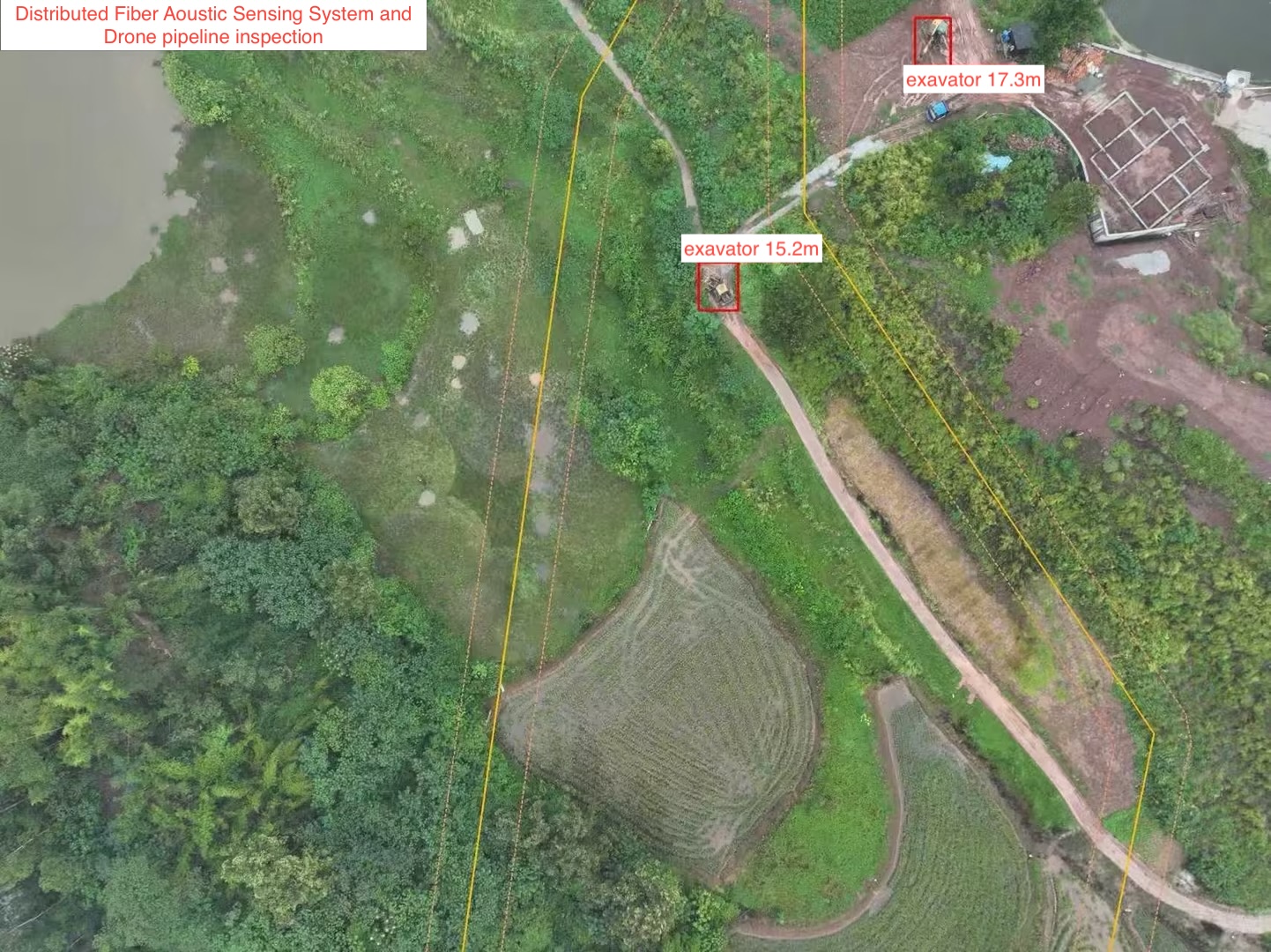
The drone streams live footage back to the control center, supports remote deterrence of unauthorized activity, and records evidence — while the event is still happening.
How a typical deployment works
From corridor assessment to an audited dispatch loop — on top of the sensing base you already have.
- Assess the corridor and assets. Record pipeline length, existing DAS coverage (up to 160 km dual channel per channel), and available drone or camera assets along the route.
- Connect the response layer. The dispatch workflow links to the coordination platform, not to a specific sensing box — legacy DAS/DVS systems can first be upgraded with AI Sentry™ to ≥95% recognition accuracy.
- Define dispatch rules. Set which event classes trigger a flight, verification thresholds, and no-fly or airspace-compliance policies for each corridor section.
- Register response assets. Assign drones and cameras to corridor sections so the platform always dispatches the nearest one with the alarm's precise coordinates.
- Operate and audit. Every dispatch, flight and video stream is archived to the evidence chain, giving operators a verifiable record of each alarm's outcome.
What UAV pipeline inspection responds to
Third-party intrusion
Excavators, drilling and mechanical activity near the right-of-way are detected acoustically in real time; the drone confirms the threat visually and supports immediate remote deterrence.
Suspected leaks
When DAS and DTS cross-verify a leak anomaly, the UAV inspects the suspected section from above — faster and safer than walking the line, especially across rivers, slopes and inaccessible terrain.
Post-event documentation
Aerial footage timestamps and records each verified event, building the evidence chain operators need for enforcement, claims and right-of-way management.
Works with the DAS base you already have
The UAV response loop connects through the coordination platform — it does not lock you into new sensing hardware. Starting fresh? See the full pipeline intrusion & leak detection solution. Running legacy DAS/DVS with high false alarms? AI Sentry™ upgrades recognition accuracy first (DAS ≥95%), so the drone is dispatched only for events worth flying.
Full solution or drone layer — your choice
UAV pipeline inspection can be deployed as part of the integrated DAS + DTS + drone/camera verification architecture, or added to an existing monitoring base. See the DAS system or talk to us about your corridor.
How the response approach compares
A factual comparison of common approaches to pipeline right-of-way patrol.
| Dimension | Periodic manual patrol | Scheduled flight patrol | DAS-triggered UAV inspection |
|---|---|---|---|
| Trigger | Calendar and shift schedule | Fixed flight plan, regardless of events | A confirmed, meter-level-located sensing event |
| Coverage | Only what the route reaches that day | Coverage during flight windows only | Full-corridor sensing 24/7 (up to 160 km dual channel), flights on demand |
| Verification latency | Hours — a crew drives to the site | Until the next scheduled flight | Nearest drone dispatched automatically with coordinates |
| Evidence | Often gone — machinery has left before arrival | Footage of unrelated sections, event may be missed | Live video and timestamped records while the event is happening |
| Cost exposure | Labor scales with route length and frequency | Aircraft time consumed by uneventful flights | Flight time concentrates on verified events only |
Frequently Asked Questions
Add automated UAV response to your pipeline
Tell us your corridor length, fiber resources and drone assets — we'll design the dispatch workflow.