
Short answer: DTS answers "how hot is my cable right now" — it detects thermal overload, hotspots and fire risk along the entire cable route with ±0.5 °C accuracy. DAS answers "what is physically touching or threatening my cable" — it detects excavation, cable theft and third-party interference as acoustic/vibration events. They are not competing technologies; they solve two different failure modes. Many operators run both on the same fiber. This guide explains when you need which, and what to check before buying either.
Author: Landsub Engineering Team Category: Technology Comparison | Reading time: ~9 min
Why this question matters
Power cable failures rarely announce themselves. A buried 110 kV circuit fails after months of thermal aging at a single hotspot. A substation cable tray ignites because one joint loosened. An export cable is damaged by anchor dragging. Each of these failure modes is invisible to periodic inspection — and each demands a different sensing technology.
Buyers searching "DTS vs DAS" usually face this decision mid-project: which technology, or both, and how do I compare vendor claims? This article gives you the engineering basis, not marketing claims.
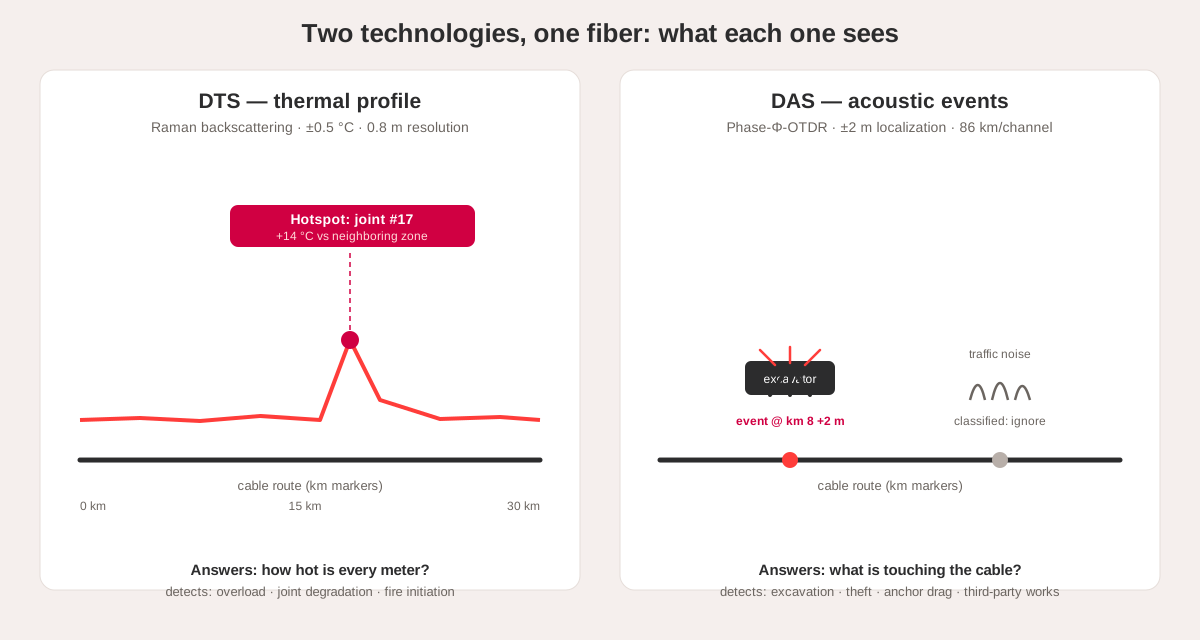
The two technologies, in one table
| Dimension | DTS (Distributed Temperature Sensing) | DAS (Distributed Acoustic Sensing) |
|---|---|---|
| Physical principle | Raman backscattering — temperature-dependent Stokes/anti-Stokes ratio | Phase-Φ-OTDR — Rayleigh backscattering phase changes from acoustic vibration |
| What it measures | Absolute temperature along the fiber | Acoustic energy / vibration signatures |
| Typical accuracy | ±0.5 °C (resolution 0.1 °C) | Sensitivity ~0.03 rad/√Hz at the vibro-acoustic floor |
| Range per channel | Up to 30 km (single-mode)/ Up to 20 km (multiple-mode) | 86 km single channel / 160 km dual channel |
| Spatial resolution | 0.8 m | ±2 m event localization |
| Alarm type | Continuous thermal profile + rate-of-rise | Event detection + classification |
| Best at | Hotspots, thermal derating, fire initiation | External intrusion, excavation strikes, cable theft |
| Deaf to | Non-thermal threats (digging, theft) | Slow thermal drift (no acoustic signature) |
Scenario 1: Thermal monitoring and fire detection → DTS
Cable insulation ages with temperature. IEEE and IEC cable ampacity models assume a maximum conductor temperature; every sustained degree above it trades years of remaining life for weeks of extra load. DTS turns the cable itself into a continuous thermometer:
- Hotspot localization at 0.8 m resolution — a failing joint shows up as a localized temperature anomaly long before it becomes a fault, and DTS tells you which joint at which meter mark.
- Dynamic rating support — with the full thermal profile, operators can safely push peak loading instead of relying on conservative static ratings.
- Fire initiation detection — in tunnels and tray rooms, the same DTS channel doubles as a linear heat detector: rate-of-rise and absolute-threshold alarms at every meter, not just every 10 m like spaced point detectors.
For fire-protection duty specifically, ask vendors for: alarm threshold configurability per zone, rate-of-rise plus absolute alarm logic, and response time at your fiber length.
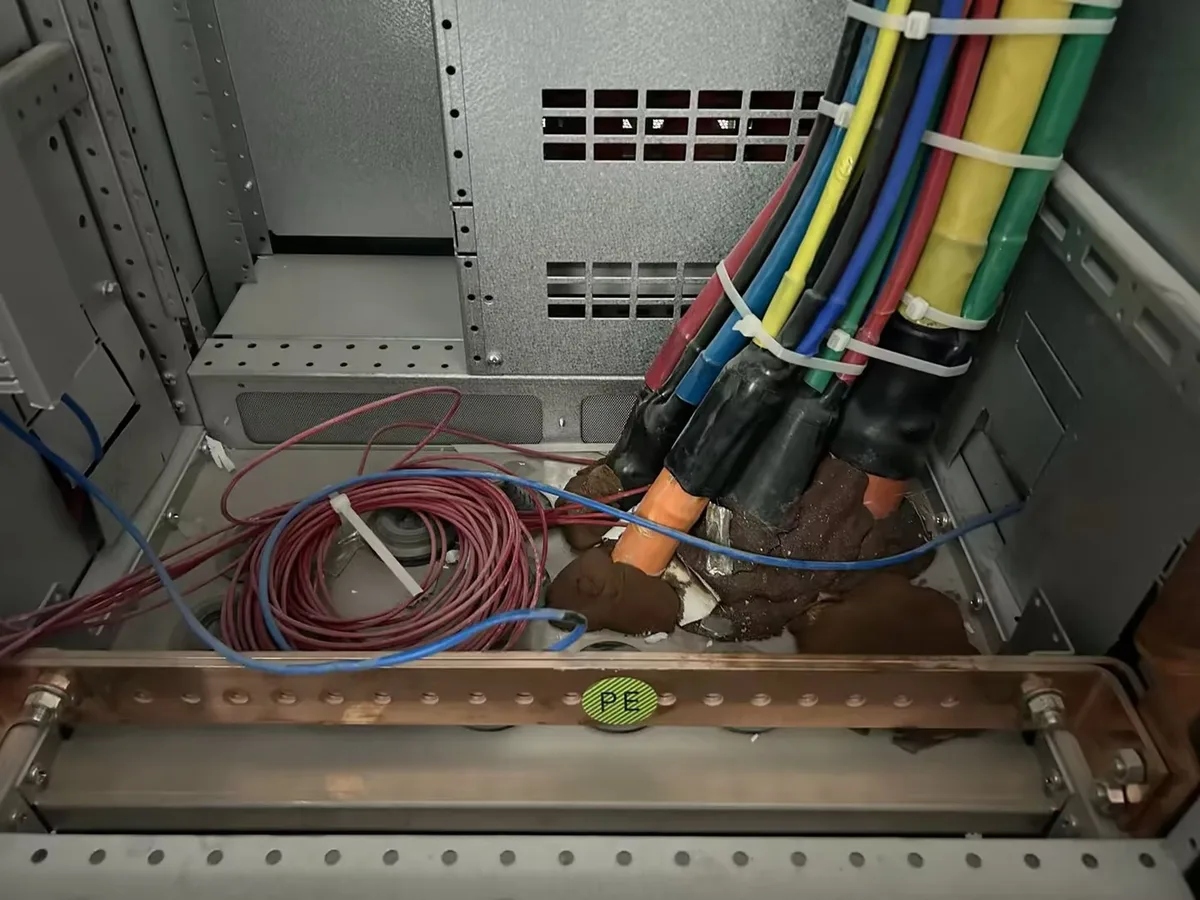
Scenario 2: External threat detection → DAS
Most cable damage in the field is mechanical, not thermal. Third-party excavation near buried cable routes, cable theft, and anchor drag on submarine exports are acoustic events — digging machinery, chain noise, vessel engines all have distinct vibration signatures. DAS continuously "listens" along the fiber:
- Early warning before the strike — excavation activity is detectable while the machine is still meters away from the cable, giving a response window that post-event fault location cannot.
- Event classification — modern systems separate digging from vehicle traffic from footfall, which is what keeps false alarms manageable on long routes (more on this below).
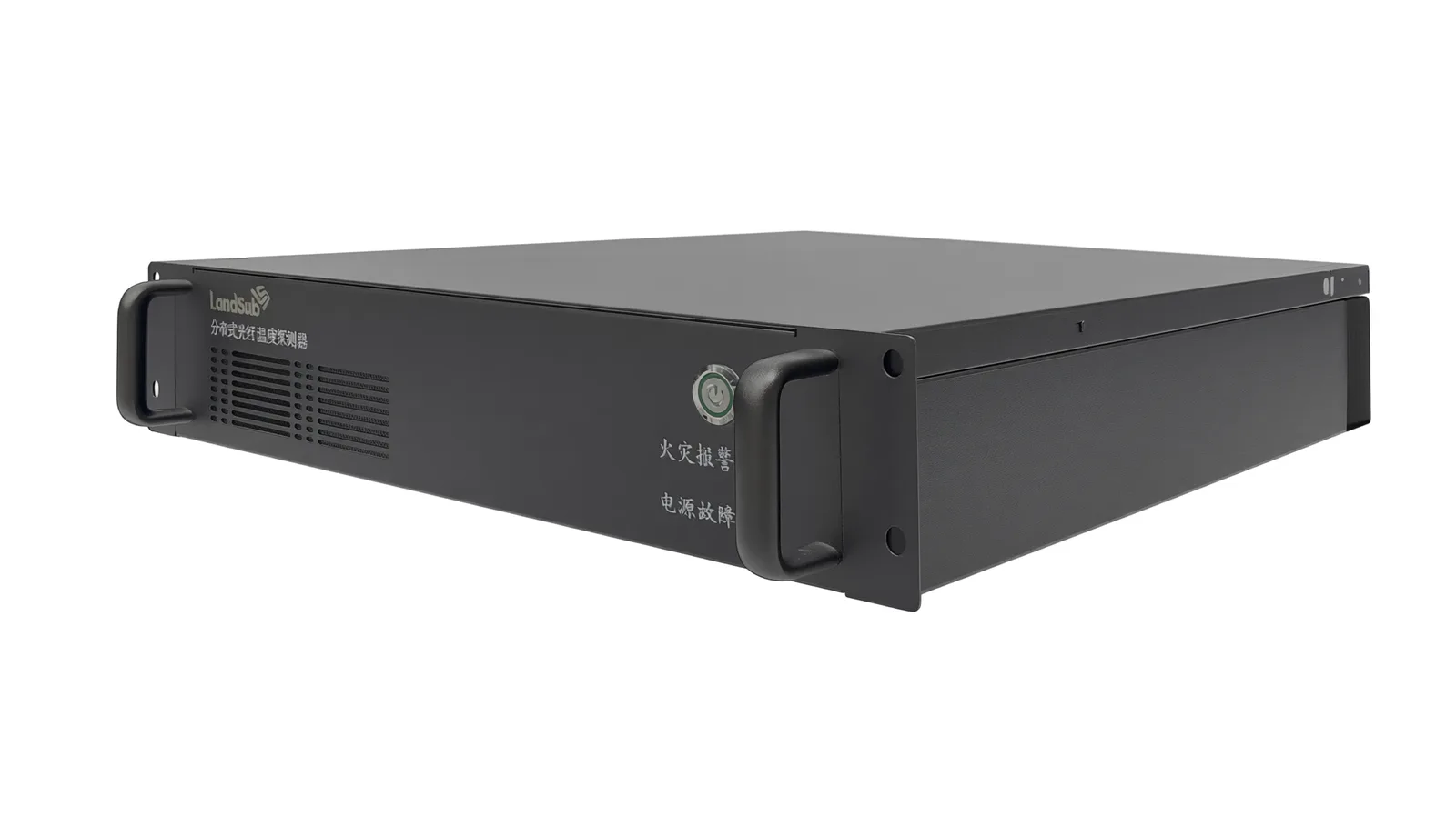
- ±2 m localization — response crews get a chainage, not a "somewhere on this 20 km section".
Scenario 3: You probably need both
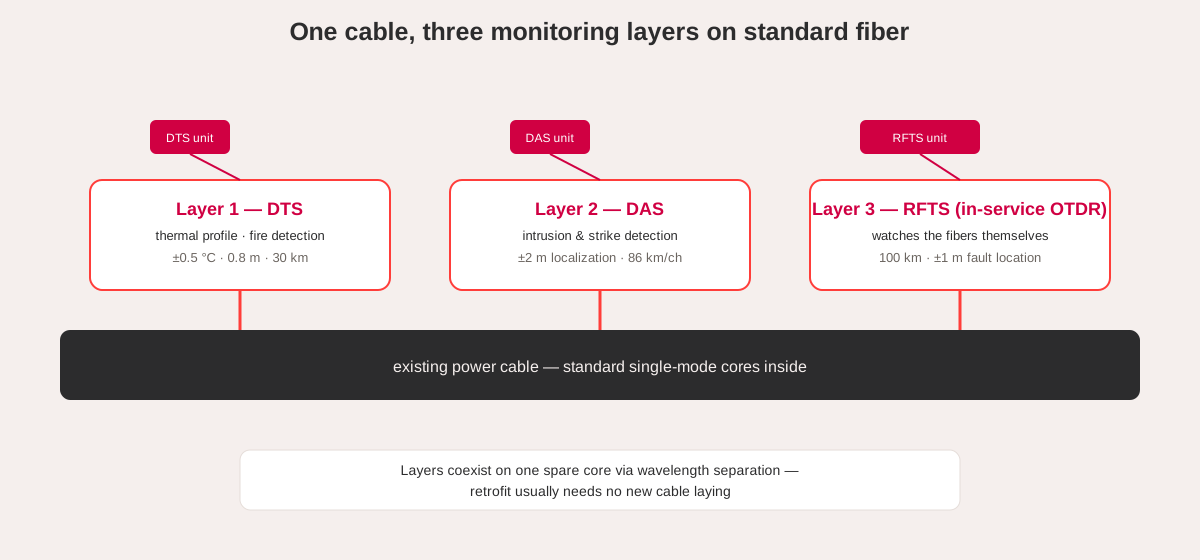
The failure modes are independent, and the economics favor combining them: both technologies run on standard single-mode fiber, and one spare fiber core in the cable can host both interrogators via wavelength separation. A common architecture on utility corridors:
1. DTS channel — continuous thermal profile, fire detection, dynamic rating. 2. DAS channel — third-party interference detection along the same route. 3. In-service OTDR monitoring (RFTS) — a third layer that verifies the sensing fiber and communication fibers themselves stay healthy (100 km range, ±1 m fault location), because a monitoring system that silently loses its fiber is worse than no monitoring system.
If your cable links carry critical load (interconnector, export cable, tunnel feed), the combined architecture is the defensible default.
The false-alarm question (what vendors won't tell you)
For DAS, the real differentiator between systems is not sensitivity — every system detects a digger — it is what happens after 30 days on a noisy corridor. Ask these questions before buying:
- What is the measured false-alarm rate on a comparable route, not in a demo yard?
- Is classification done on-device with trainable models, or is every event a human review?
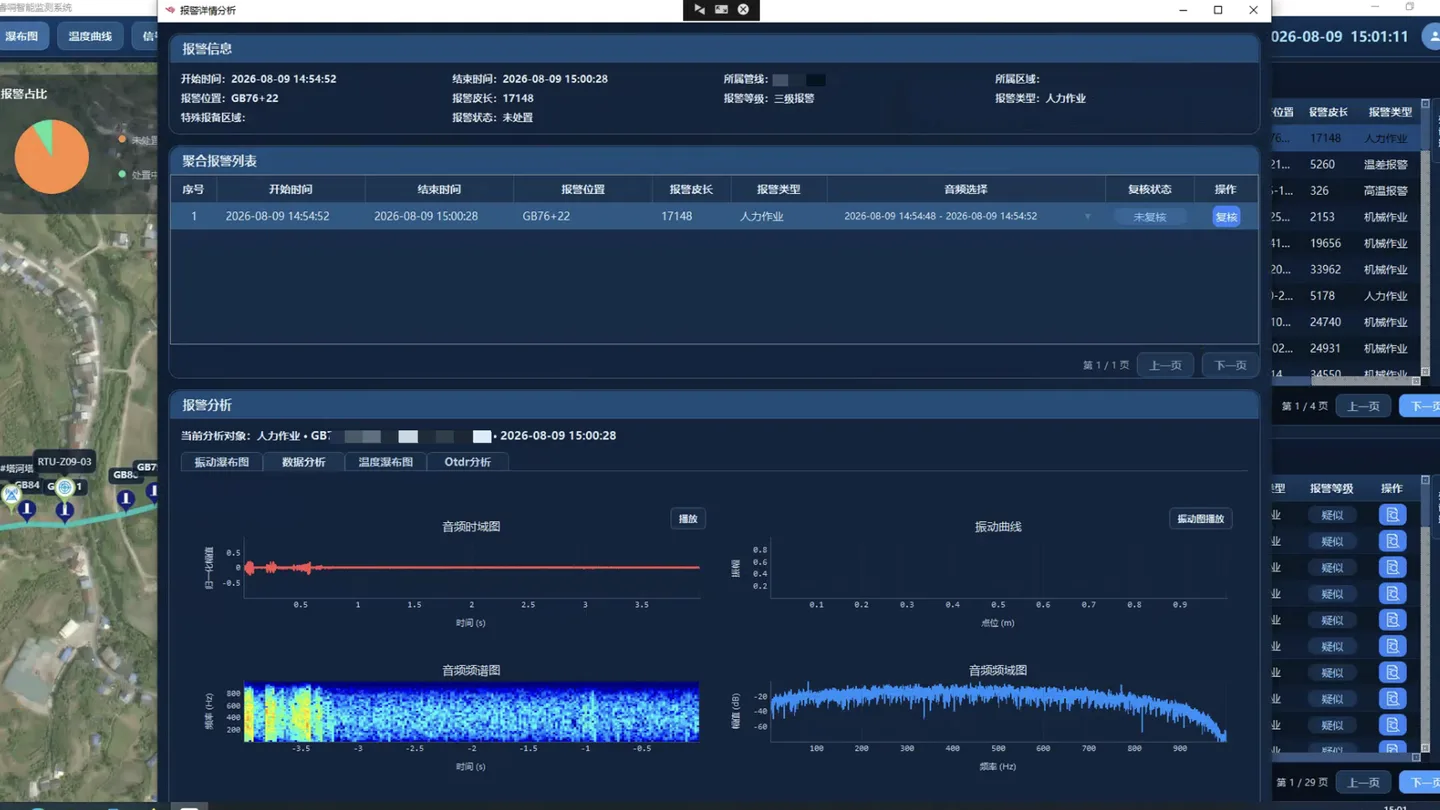
- Can the system be upgraded in the field? (AI pattern-recognition upgrades to existing DAS/DVS units now exist — recognition accuracy ≥95% for DAS and ≥90% for DVS event classes — which changes the lifecycle cost equation: you upgrade the brain instead of replacing the hardware.)
Specification checklist (copy into your RFQ)
- Range per channel at required spatial resolution (not at degraded resolution)
- Temperature accuracy: absolute (±0.5 °C) vs resolution (0.1 °C) — vendors quote whichever is flattering
- Localization accuracy under field conditions
- Alarm logic: absolute threshold + rate-of-rise + zone customization
- Event classification classes and reported accuracy
- Fiber budget: does the system survive on the spare core of existing cables
- Hardware upgrade path for detection software (AI models)
- Standards alignment (IEC 61757 series for fibre optic sensors)
FAQ
Can DTS detect a fire before smoke detectors do?
In tunnels and enclosed tray rooms, yes in practice: DTS sees the temperature rise at the exact cable location from the first seconds of abnormal heating, while smoke needs transport time to reach the nearest detector. Along open cable routes there is no smoke-detector equivalent at all — that comparison is DTS versus nothing.
Is one fiber enough for both DTS and DAS?
Yes. Both interrogators can share one core via wavelength separation, and both coexist with the communication fibers on the cable. This is also why retrofits are usually possible without new cable laying.
What about DTSS-BOTDR — where does it fit?
DTSS-BOTDR measures strain and temperature simultaneously (±5 με strain accuracy, ≤1 s measurement). It is the right choice when the mechanical condition of the cable or attached structure matters — cable sheath stress, joint movement — as in tunnel and bridge structural health monitoring, rather than pure thermal or acoustic duty.
How far can one channel reach?
Current generation: 86 km per DAS channel (160 km dual channel) and 30 km DTS on single-mode fiber (20 km on multimode). Long routes are covered by cascading channels, which is a cost question rather than a feasibility question.
This article aligns with the IEC 61757 series (fibre optic sensors). Landsub Global engineers field questions on combined DTS/DAS/RFTS architectures at [landsubglobal.com](https://www.landsubglobal.com/en/).