
Short answer: A pipeline leak detection system is not one technology but a layered defense. Computational pipeline monitoring (CPM) watches flow and pressure balance; fiber-optic sensing watches the right-of-way itself — Distributed Acoustic Sensing (DAS) catches third-party intrusion and releases as vibration events along hundreds of kilometers, while Distributed Temperature Sensing (DTS) catches thermal anomalies from leaking product. Regulators increasingly expect continuous, internally verifiable detection — and fiber is the only technology that delivers continuous coverage of both the product and the right-of-way on one installed cable. This guide maps the methods, the standards that reference them, and the checklist to use before you buy.
Author: Landsub Engineering Team Category: Pipeline Integrity | Reading time: ~11 min
---
Why this question matters
A leak on a liquids or gas transmission line is three losses at once: product, compliance exposure and — worst of all — the right to operate. Operators searching "pipeline leak detection system" are usually in one of three situations:
1. New build — the right-of-way design is open, and detection architecture can be engineered in from day one. 2. Regulatory upgrade — an existing line must meet tighter integrity expectations in high-consequence areas, and periodic aerial patrol plus CPM no longer feels defensible. 3. Repeated incident response — third-party strikes or small seepage events keep happening faster than patrols can find them.
All three share one engineering question: which detection layers cover which failure modes, and what does continuous coverage actually cost? That is also the structure of our longer Pipeline Leak Detection Handbook (PDF — see the end of this article), which goes deeper on sizing, alarm thresholds and integration.
The four families of leak detection methods
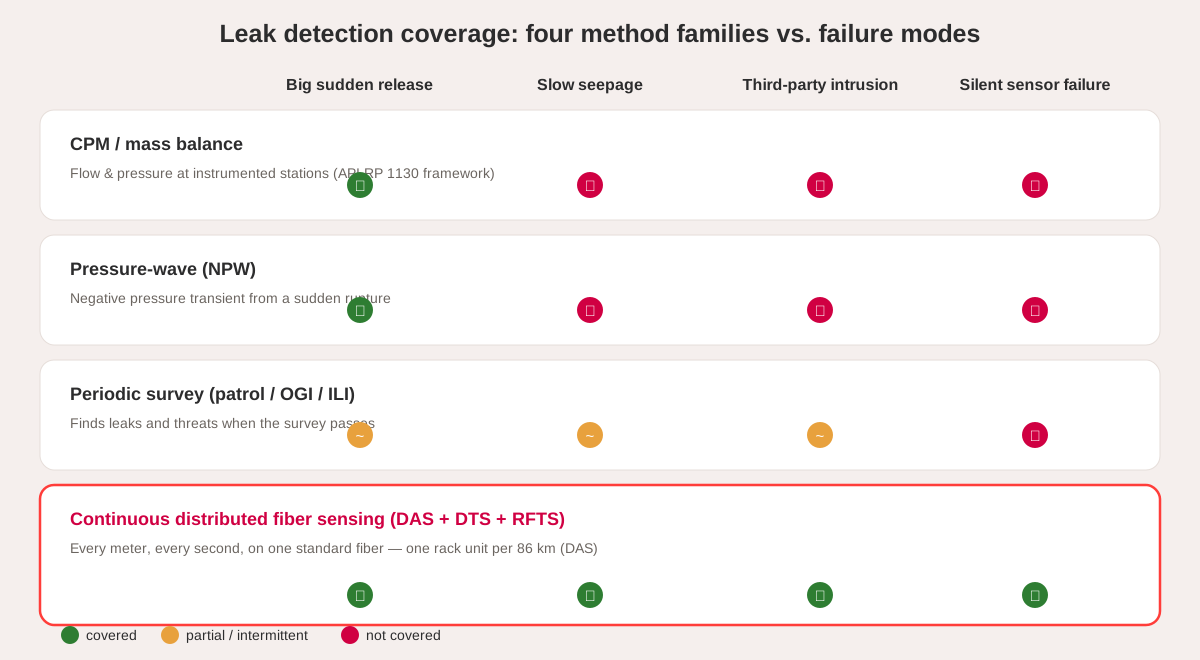
Every leak detection system on the market falls into one of four families. A defensible program usually combines at least two.
| Family | How it detects | Strengths | Blind spots |
|---|---|---|---|
| Computational Pipeline Monitoring (CPM) — mass balance, pressure/flow deviation, rate of change | Infers a leak from instrument readings at stations | Mature; standards exist (e.g., API RP 1130); no right-of-way hardware | Blind between instruments; slow for small seeps; depends on meter health |
| Pressure-wave / negative pressure wave (NPW) | Detects the pressure transient a sudden rupture creates | Very fast for large sudden releases; low cost | Misses slow seepage entirely; sensitivity drops with distance from taps |
| Periodic survey — aerial patrol, OGI camera rounds, in-line inspection | Finds leaks or threats when someone/something passes | Visual confirmation; combines with ILI integrity data | Intermittent by definition — a leak between patrols runs unobserved |
| Continuous distributed fiber sensing — DAS, DTS, RFTS | Senses the entire right-of-way continuously through a standard optical fiber | Continuous coverage; also detects third-party intrusion before a leak exists; one cable, multiple sensing layers | Requires an optical fiber along the route (new builds: trivial; existing routes: often a spare core already exists) |
The pattern that emerges across incident histories is uncomfortable: CPM and surveys mostly confirm leaks; distributed fiber sensing is the main family that can catch the pre-leak threat — the excavation strike, the unauthorized tie-in, the ground movement — while it is still an acoustic event meters away from the steel.
What a fiber layer actually adds to a leak detection system
A single fiber-optic cable in the right-of-way can host three independent sensing layers on different wavelengths, each covering a failure mode the others cannot:
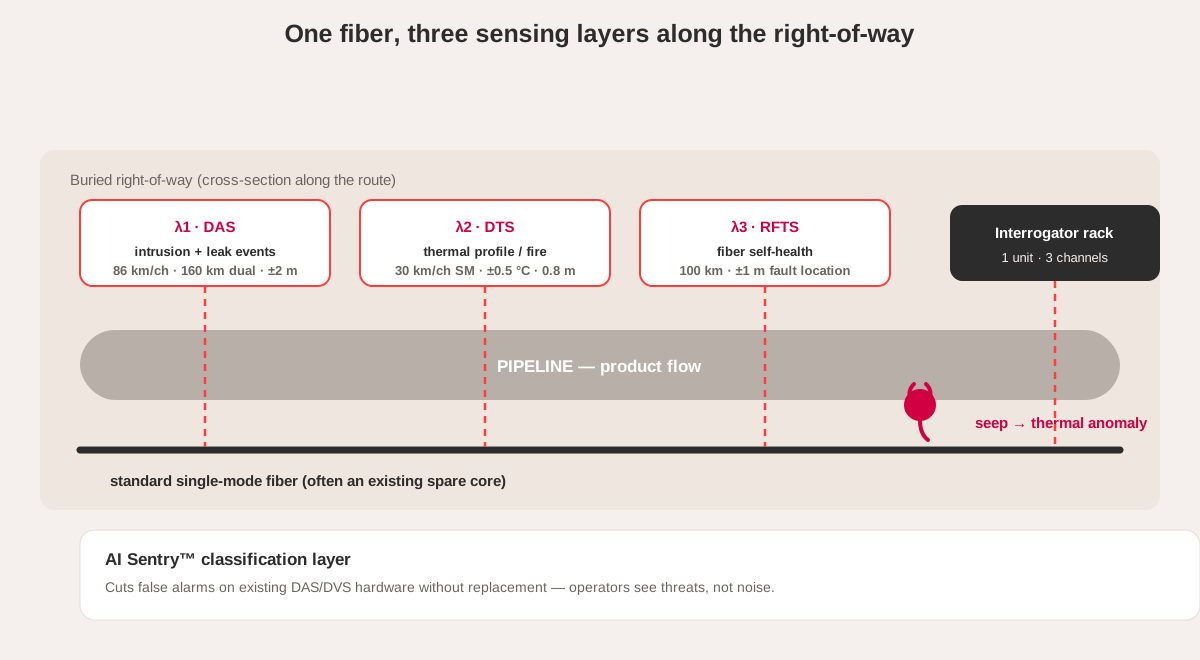
1. DAS — Distributed Acoustic Sensing (third-party intrusion + leak events). The fiber becomes a continuous microphone array. Excavation machinery, vehicle movement, manual digging and flow anomalies each have distinct vibration signatures. Modern interrogators classify events and localize them to within about ±2 m, on routes up to 86 km per channel (160 km dual channel) — one rack unit covering what used to take dozens of patrol-tended sensor nodes. 2. DTS — Distributed Temperature Sensing (thermal leak signatures). Escaping product changes the ground temperature — gas expansion cools, warm liquids heat. DTS reads the full temperature profile at 0.8 m spatial resolution with ±0.5 °C accuracy, so a seep the CPM model would average out shows up as a persistent local anomaly at a chainage you can walk to. 3. RFTS — In-Service OTDR monitoring (the layer that watches the watchers). A sensing system that silently loses its fiber is worse than no system. In-service OTDR monitoring verifies fiber health continuously across 100 km with ±1 m fault location, so a cut or degraded span raises an alarm, not a coverage gap.
The economic argument is coverage density: a fiber layer produces a measurement every meter, every second, while CPM produces a computation every few seconds at a handful of instrumented points. For third-party interference — the leading cause of pipeline failures worldwide — that difference is not incremental. A third-party intrusion detection system built on DAS gives operators a warning window measured in minutes before impact; patrols and CPM give a notification after it.
Third-party intrusion: the failure mode that precedes the leak
Industry integrity statistics consistently place third-party activity — illegal tie-ins, excavation damage, sabotage — among the top causes of pipeline incidents. The detection problem is distinctive: the threat is outside the pipe, so pressure and mass balance see nothing until it is too late.
That is what makes DAS the backbone of a modern pipeline intrusion detection system:
- Detection before contact. Mechanical excavation is acoustically detectable while the machine is still meters from the pipe — a response window, not a post-mortem.
- Classification, not just alarm. The value of a fiber layer lives and dies on false-alarm discipline. Systems must separate digging from farming, traffic from trespass, and rainfall from anything at all — which is why we treat AI-based classification as a first-class product layer (see below).
- Chainage localization. Response crews get a meter mark on the line, not a "somewhere in this 40 km section".
AI classification: the layer that makes fiber alarms actionable
A long DAS route produces a very large event stream. Without classification, operators drown in alarms and disable the system — the classic failure mode of early fiber deployments. AI Sentry™ addresses exactly this: it injects trained pattern recognition into existing DAS/DVS systems and cuts false alarms without replacing hardware, learning the acoustic fingerprint of your right-of-way (roads, rail crossings, farms, riverbeds) and flagging only the signatures that match real threats.
For buyers, the practical test is simple: ask any vendor what percentage of alarms their system requires an operator to dismiss by hand, and what happens to that number in the first month after commissioning. The answer tells you whether you are buying a sensor or an operable detection system.
Buyer's checklist: what to specify before you buy
| # | Specification item | Why it matters |
|---|---|---|
| 1 | Coverage per channel (km) at your fiber length | Range claims assume clean fiber — validate at your actual route length |
| 2 | Event localization accuracy (m) | Determines response dispatch precision |
| 3 | Classification performance and false-alarm rate | The difference between a system operators trust and one they mute |
| 4 | Intrusion detection distance ahead of the threat | Your actual warning window |
| 5 | Leak-signature coverage (thermal/acoustic) for your product | Gas, crude and refined products have different signatures |
| 6 | Fiber-health self-monitoring (e.g., in-service OTDR) | A monitoring system must not be able to fail silently |
| 7 | Integration path with SCADA/CPM | Fiber events should enrich, not replace, your CPM record |
| 8 | Spare-fiber requirement | Existing routes can often run on a spare core — no new construction |
FAQ
How far can a fiber-based leak detection system cover from one location? A single DAS channel covers up to 86 km of route; two channels reach 160 km from one rack unit. DTS channels cover up to 30 km (single-mode fiber) per channel. Long corridors are covered by daisy-chaining interrogators at repeater points.
Does fiber sensing work on an existing pipeline, or only new builds? Both. New builds embed the cable during construction. Existing pipelines can often use a spare fiber core in a telecom cable already laid along the right-of-way — no pipeline modification, no in-line hardware.
Will fiber sensing replace CPM? No — and it should not. CPM remains the regulatory backbone for product balance. Fiber sensing covers what CPM cannot see: the right-of-way itself, especially third-party activity and pre-leak threats. The strongest programs run both and integrate the event streams.
How is a small seepage leak detected if it makes no acoustic event? Through the DTS layer: escaping product produces a persistent local thermal anomaly on the ground-temperature profile. Slow seeps are a temperature problem more than an acoustic one — which is why a complete fiber layer includes both DAS and DTS.
Go deeper: the Pipeline Leak Detection Handbook (PDF)
This article compresses what the handbook expands. The Pipeline Leak Detection Handbook covers, chapter by chapter:
1. Method families and their detection physics, with selection trees by product type and line size 2. Standards and regulatory expectations for continuous detection 3. Sizing fiber sensing: channel budget, localization and alarm-threshold design 4. Third-party intrusion detection: siting, classification tuning and response workflows 5. Integration architecture with SCADA and CPM 6. A commissioning and acceptance test plan you can hand to a vendor
Request the handbook: contact [[email protected]](mailto:[email protected]) with your line length, product and primary threat profile, and we will send the PDF plus a first-pass feasibility comment on your route.
---
Landsub Global builds distributed fiber optic sensing infrastructure — DAS, DTS, DTSS-BOTDR, in-service OTDR monitoring (RFTS) and the AI Sentry™ false-alarm reduction layer — for pipeline, power and transport operators worldwide.